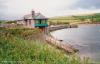
Wreck of the 'Ceres' 1866
The Wreck of the ‘Ceres’. 1866. | A Survivors’s Story. | ||||||
|
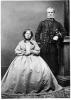
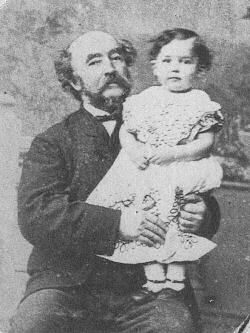
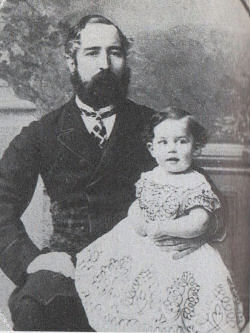
Twenty-nine passengers and nine of the crew of the ‘Ceres’, a steamer with sails, en route from Plymouth to Dublin, struck the shore about a mile westward of Carnsore Point on the evening of the 10th.November 1866. The vessel was about 20 miles off course at the time, a discrepancy attributed by the captain at a later enquiry to the compasses being ‘astray’. The survivor who left the vivid description of the wreck was Dr.Robert Lynn Heard, MD, FRCSI, who was a native of Donaghadee, Co.Down, served in the British army with the Hampshire regiment (with which unit he was present at the sack of Peking in 1870). His father, who also survived the wreck, was Richard Griffith Noble Heard, Chief Inspector of the Coastguards and was stationed for a time at Kinsale. Dr.Heard’s wife, the pregnant lady who also survived the wreck, was the former Ellen Haughton. The child who was rescued from the battered hull, was Robert Lynn heard, Junior. Dr.Heard accompanied by his wife, ten-months-old son , father and nurse Bessie gogarty, boarded the ‘Ceres’ at Plymouth on November the 9th. Here is an (abridged) account) by Dr.Heard:- After tea on the 10th. as the weather worsened I went on deck heard the captain saying to his men on look-out “to keep a sharp lookout”. Shortly afterwards a man rushed up to the captain and said to him; We are in among the breakers and pointed to the port quarters. The captain called out ”Port, hard to port” and rushed to the telegraph to communicate with the engine room. I descended to the saloon and met my family. Most of the people in the cabin rushed on deck. I and my party assembled at the upper part of the saloon and on our knees commended ourselves to God’s care. The seas struck the vessel violently, breaking the woodwork, and flooded into the saloon. We scrambled up a passage to some cabins at the highest part of the ship and heard the water coming closer, I managed to open a skylight . On deck some sailors told me we were off the coast of Wexford. After much difficulty they lit some emergency blue lights which landed on what seemed to be a beach. I told my wife there was a ray of hope and remained with them for some time when I again made my way on deck and found that the captain and crew had gained the shore. I then cried out to those on shore that there were women still on board but over the storm someone shouted something out to me which I could not make out. I then got up to the skylight and showed a soldier and an engineer how they might get down to the beach. I called to my wife to make her way up to the skylight and I could pull her out, having warned her to take off her outer dress and crinoline, which I knew would prevent her getting through the opening. She wanted the child to be taken out first, but I was afraid he would be washed away if I laid him anywhere on deck and I could not hold him and help her as well, so my father took him in his arms and managed to shove my wife up far enough for me to get a hold of her. At last I got her on deck and round to the main rigging by which she let herself down by the rope and was received on the beach by one or two men who came down to help her from the sea. I watched her been taken to safety and returned to the skylight and called for the nurse, Bessie Gogarty, to come up next. My father answered that the waves ad broken further parts of the cabin and the nurse and an American lady had been carried away with it. I then asked him to try and get up, not to mind the child whom I considered it impossible to save, but to come himself .He said it was impossible,, but at all events he would not leave the child. I threw a rope down to him and called out to him, but there was no response. I concluded that he had fallen into the sea and that the child perished with him. I descended, easily, by the rope on to what was almost dry sand. and found my wife. We knelt in prayer and thanked God for our deliverance tho’ he had taken my father and our child. We were looked after with great kindness at a cottage near-by, and then taken to the house of the Honourable Major Keane nearby and Ellen was put to bed. About 11 p.m. I said I would go back to the scene of the wreck, where I was told that my father had come ashore an hour or two before and was in a cottage having left the child for dead in one of the berths of the vessel. On hearing that my child (Bobby) had been left in a berth even though presumably dead, I tried to get aboard but could not. I offered £1 and the £5 to anyone who would bring the child ashore. A sailor attempted to climb into the vessel and failed Another got up the rope and after some time of suspense, I had the pleasure of seeing him reappear with a blanket tied round his neck so as to leave his arm free and containing Bobby alive. He had found Bobby in the berth where he had been laid by my father, covered by boards and debris of the wreck but uninjured. The next morning (Sunday) we three awoke well and were joined by my father, also well, he having slept in a house near at hand The following morning on going down to the wreck at 8 o’clock I found some of my baggage under the charge of a Coastguard. I found on the beach my wife’s trunk open and emptied , one of the straps cut cleanly with a knife. Shortly afterwards I saw a man carrying in his hand a lavender-coloured silk dress of my wife’s which he had found and with which he meant to cover a body. I took it from him and it was quite dry and with the exception of two or three slight stains was quite undamaged. My wife Ellen was the only woman saved and Bobby the only child saved of all the women and children on board. Reference; “Tales of the Wexford Coast” by Richard Roche. R.N.L.I. Award Wreck of a Screw Steamer.
Reference; Saunders News Letter Saturday 25th.October 1851. |
Tweet

 Posted by Tony
on September 07 2007
Posted by Tony
on September 07 2007