South Dublin Gossip.
No Dalkey Man Need Apply.
Is it a fact that the Dalkey Amusement Committee, having advertised for a caretaker for Sorrento Grounds, are keeping the job open until a certain coastguard shall have been relieved from that branch of the service on pension ? We understand that several men from the town have applied for the position, but none of them have been selected. We fail to see how a retired sailor is the most fitting person for this job. As there is a clause in the lease preventing fishing or shooting game on the grounds, the committee evidently think the old coastguard would be the most likely man to put a stop to such practice, though we believe the man who would go fishing or fowling on Sorrento Hill would display one of those prominent traits of character that would go a long way to qualify the possessor for a lunatic asylum. There are no birds there, at least none to speak of. In fact there is neither fish nor fowl nor- oh yes there is flesh there in abundance, but we are not aware that flesh is one of the forbidden articles in the lease, and though there may be some couples there. The only shooting that is done is the flash shot-forth from the eye of youth and beauty. Where then does the superannuated man-of-war man come in as being more useful than the other men looking for the job? This puzzle is too much for us. We give it up. (2)

Wit & Wisdom of Ireland.
The world's greatest wits have been Irish - Swift, Sheridan, Wilde, and Shaw to name but a few. The Irish, said Samuel Johnston , are a very truthful race. They never speak well of each other. While in other countries everything may be serious but not hopeless, in Ireland everything is hopeless but not serious.
|
Darbys Point.
Station consists of 8 cottages for Chief Boatmen and 7 men. There is no difference made between the cottages of the Chief Boatman and those of the crew. But from my own long experience of the service I am inclined to think that if his attention was drawn to it the Commodore Controller General would wish that in the special case of a Chief Boatman in Charge, some slight addition should be made to his quarters by way of distinguishing between him and his men.
| Unsubscribe
| Coming in October Edition The Sinking of the "Pomona"
|
| | Dear Friend, Welcome to the September edition of "The Coastguard Cutter".
| The Irish newspapers gave good coverage to the humanitarian work done by the Coastguards when life was at risk. However there were some individuals who liked to criticise, even when they did not have full knowledge of a rescue event. Enjoy,
Tony.
| 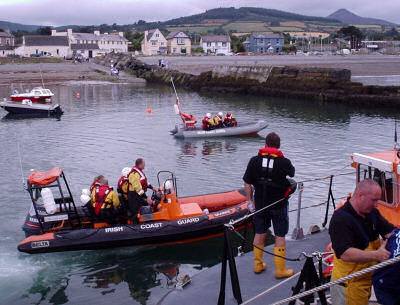
Recent combined exercise at Greystones, Co.Dublin. Included R.N.L.I., Howth and Greystones Irish Coast Guard.
LETTER. 1880.
To the Editor of the Freeman 29th.October
Sir – In your report of the lamentable shipwreck in the bay upon yesterday morning, it appears the vessel went ashore at half past 8 o’clock am – broad daylight- and the lifeboat, manned by a dragoon officer, (in command), some soldiers and a few sailors and fishermen, did not reach her till half past eleven, by which time the master and two of the crew were drowned. Now our soldiers are very brave and daring fellows no doubt; but surely they cannot be expected to possess the requisite experience and knowledge for the management of a lifeboat at any time, much less in bad weather. How comes it, then, that the paid coxswain, Mr. Brown, of Ringsend, and the volunteer crew, who are exercised in the boat every three months and paid for each exercise, were not there. And what is the use in having a lifeboat without an efficient crew, ready and willing to man her whenever a gale like the last springs up ? It appears from another report that an irresponsible member of the Coastguard refused to allow the lifeboat to be launched unless the officers of the Pigeonhouse Fort held themselves responsible for her safety. What authority had he to make such ridiculous stipulation ?. He should also have held them responsible for the safety of her crew. How was it that the Coastguard on duty, who should have seen the vessel when she struck, did not take steps to collect a crew ?. And what prevented himself and his comrades from forming part of the crew that did go ?. Was it want of pluck ? Perhaps the Irish Auxiliary Branch of the Royal National Lifeboat Institution may be able to throw some light on this bungle. I am, sir, etc. Mercantile Marine.
P.S.- The admirable conduct of the gallant dragoon may, I think, be accepted as proving the existence of that hitherto mysterious corps the “Horse Marines”, and trust that all other branches of the service may be found equally ready in similar emergencies. (1)
Shipwreck in Killiney Bay. 1899.
During the early hours of Monday morning a large vessel of 1;818 tons burden was driven ashore on that most unapproachable coast-line which surrounds Killiney Bay. About three o’clock on that morning Mr. Grogan, assistant stationmaster at Ballybrack heard the cries of human beings in distress. When he caught sight of the ship, and saw the danger in which the crew were placed, he immediately telephoned to the coastguards ay Kingstown and Bray. About seven o’clock a tug-boat from Kingstown bore down upon the wreck but dare not approach her, as by so doing the tug would be placed in as dire a plight as the ship. Shortly after the coastguards arrived, with all the pride, pomp, and circumstances of life-saving apparatus, but with all their paraphernalia they were unable to throw a line aboard the ship. What are coastguards for ? Are they kept for use or ornament. Anyone looking at their futile efforts on Monday morning would certainly say the latter. Three of the crew of the ill-fated ship, disgusted, no doubt, at the vain attempts of the coastguards, launched a boat and put off for the shore, but the restless surf soon swamped the boat and threw its occupants into the angry waves, which fairly danced with delight at their expected victims., but fate otherwise willed it.. Mr. John O’Masterson of Killiney, and others came to their assistance and were not long in getting the exhausted sailors ashore. Shortly after 9 o’clock the lifeboat from Kingstown took off the remainder of the crew. The vessel is the ‘Lough Fergus’, of Liverpool, and was bound to Brisbane. She had a crew of 18, with two stowaways. The ship was commanded by Capt. Williams. (3) |
Shipwreck
The Huntly of Liverpool, Captain Hannah, timber laden sailed from St.Andrews N.B. for Liverpool on the 12th.January last. On the 4th.February in a tremendous gale the ship became unmanageable, was stove in by a heavy sea, and waterlogged. The crew 16 in number, with the captain, at a distance of 600 miles from the shore, abandoned the vessel, took to the boat, without being able to provide compass, water or provisions. They consigned themselves to the mercy of the elements, not knowing what course to steer and continued before the wind for 9 days during which one of the crew died from exhaustion and several others were sinking fast. Sunday week (the ninth day) they discovered land and reached the Island of Innisboffin, on the coast of Mayo. Mr. Hildebrand, land steward to the Marquess of Sligo and Mr. Carter, Commander of the Hamilton , Revenue Cruiser, afforded the poor sufferers every attention, not withstanding which, two more expired in few days after they were landed. They have been sent to the Infirmaries of Westport and Castlebar. When the boat reached the shore the inhabitants judging from the wretched appearance of the poor sufferers that they were infected with the much dreaded cholera, refused to render them any assistance. (5)
The Coastguard stations were conspicuous all around the Irish coast. A great deal of time was spent keeping them spick and span, much use being made of whitewash. Two hours each morning were devoted to cleaning duties, but on Saturdays this was extended since it was followed later by the Chief Officer’s inspection. Twice a month the Divisional Officer inspected the station, checking particularly the cleanliness of the houses.
|
|


 Posted by Tony
on June 17 2007
Posted by Tony
on June 17 2007



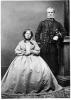
 Henry Bray, Chief Officer, Gr...[6230]